Have you ever noticed that every home has spaces that seem to be frequently forgotten? Forgotten spaces do not necessarily mean spaces that are rarely used. Laundry areas, storage corners, and utility rooms are actually part of the activities most often carried out at home, but their arrangement and design are rarely considered as carefully as those of other rooms.
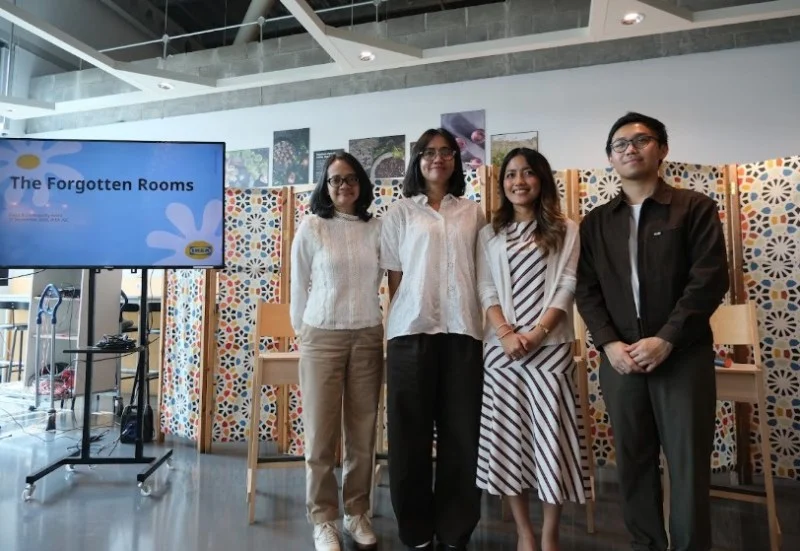
Through The Forgotten Rooms at IKEA Jakarta Garden City, IKEA Indonesia invites people to take another look at these areas by understanding what actually happens in them, from the activities carried out and the items needed to how one activity transitions into the next.
“During our visits to various homes, we saw that people already have their own ways of organizing their homes. However, from this we could also see the parts that still felt inconvenient,” said Ruth Panjaitan, Home Furnishing & Competence Development Leader IKEA Indonesia at IKEA Jakarta Garden City, Jakarta, Thursday, 17 September 2026.
“For example, when someone has to go back and forth to retrieve items, move them, or find a place to store them. That is where we began to understand that organizing a home is not merely about having a place to store things, but also about how the space can help people carry out their activities,” she continued.
Observations through Home Visit IKEA, together with insights from the Life at Home report, form part of IKEA’s way of understanding life at home. This approach is in line with IKEA’s vision of creating a better everyday life for the many people.
Photo: IKEA — Photo source: IKEA
That is because every home ultimately has different habits, so arranging a space can begin with how the activities in it are carried out to make them feel easier. The laundry area, for example.
The problem does not always lie with the washing machine or the size of the room. Usually, the problem lies in the series of activities before and after washing: clothes need to be collected and sorted, dried, folded, and then stored again.
When the space for each of these activities is not clearly organized, clothes and laundry supplies may be moved around before finally being returned to their places. The same space can feel more inconvenient not because it is too small, but because its flow does not support what needs to be done there.
“When we look at an item, the usual question is, ‘Where should this be placed?’ However, we can start with different questions: what activities are carried out here, who uses it, and what items are needed most often?
Photo: IKEA — Photo source: IKEA
From there, we can see what needs to be within easy reach, what can be stored farther away, and which spaces can actually still be used,” explained M. Yusuf Attorik, commonly known as Torik, Interior Design Leader IKEA Indonesia.
This way of looking at spaces can also be applied to storage areas under stairs, garages, small storage rooms, or a corner of the home. When storage needs increase, vertical space, walls, corners, and areas around existing equipment can be used as solutions without having to create a new room.
However, making use of space does not mean filling every corner; room to move and carry out activities still needs to be taken into account.
Photo: Jakartakita.com/Henry — Photo source: Jakartakita.com/Henry
“At the very least, we should have around 60 cm of room to move so that it does not feel cramped. That is why vertical space is often chosen to add storage for items or equipment in the home without making the rooms narrower,” explained Torik.
Storage needs can also change as activities at home change. Therefore, storage solutions need to be flexible enough to adapt to the space and the items being used. Various IKEA systems and solutions, such as BROR, IVAR, EKET, HYLLIS, and other storage ranges, can be used according to the needs of the space, the type of items, and the way each person uses them.
Ultimately, arranging a space does not mean finding one single solution that is right for every home. After understanding the activities that take place in it, we can identify the most suitable solutions, from making use of vertical space and rearranging locations to choosing storage that makes items easier to reach, use, and return.
In this way, spaces that previously felt crowded or underused can function to their full potential and support activities.
For people looking for IKEA-style inspiration and home organization solutions, various options can be found by visiting the nearest IKEA Indonesia store, through IKEA.co.id, the IKEA Indonesia app, or IKEA Indonesia’s official e-commerce channels. (Henry)
#IKEA #FunctionalHome #SpaceOrganization #InteriorDesign #HomeInspiration #ItemStorage
Comments 0
Sign in with Google or Facebook to like, save and comment.